


In November, investors faced a brief period of volatility across major asset classes. While year-to-date returns remain strong across stocks, bonds, and international markets, concerns about artificial intelligence-related companies and changing expectations for Federal Reserve policy affected performance, with considerable variation in impact across sectors. At the same time, a federal government shutdown delayed several key economic reports, limiting insight into short-term trends.
Despite these hurdles, many parts of the market stabilized by month’s end. For long-term investors, this period underscores the importance of maintaining a well-diversified portfolio designed to withstand normal fluctuations. Successful investing depends on staying focused on long-term goals rather than reacting to short-term headlines or chasing recent gains.
What influenced November’s market behavior, and how can investors keep perspective as the year wraps up?

When markets get volatile, clarity matters.
Download our educational guide, How to Protect Your Wealth in Challenging Markets.
Key Market and Economic Drivers in November
The S&P 500 rose slightly by 0.1 percent in November. The Dow added 0.3 percent, while the Nasdaq declined 1.5 percent. Year-to-date, the S&P 500 is up 16.4 percent, the Dow is up 12.2 percent, and the Nasdaq is up 21.0 percent.
The VIX ended the month at 16.35 after reaching a mid-month high of 26.42.
The Bloomberg U.S. Aggregate Bond Index gained 0.6 percent during November and is up 7.5 percent year-to-date. The 10-year Treasury yield ended the month at 4.02 percent after briefly falling below 4 percent.
International developed markets gained 0.5 percent in U.S. dollar terms based on the MSCI EAFE Index, while emerging markets declined 2.5 percent based on the MSCI EM Index. Year-to-date, the MSCI EAFE Index has gained 24.3 percent, and the MSCI EM Index has gained 27.1 percent.
The U.S. dollar index finished at 99.46 after crossing above 100 earlier in the month. Bitcoin declined about 17 percent in November, ending near 91,176 dollars. Gold ended the month at 4,218 dollars, below the October all-time high of 4,336 dollars.
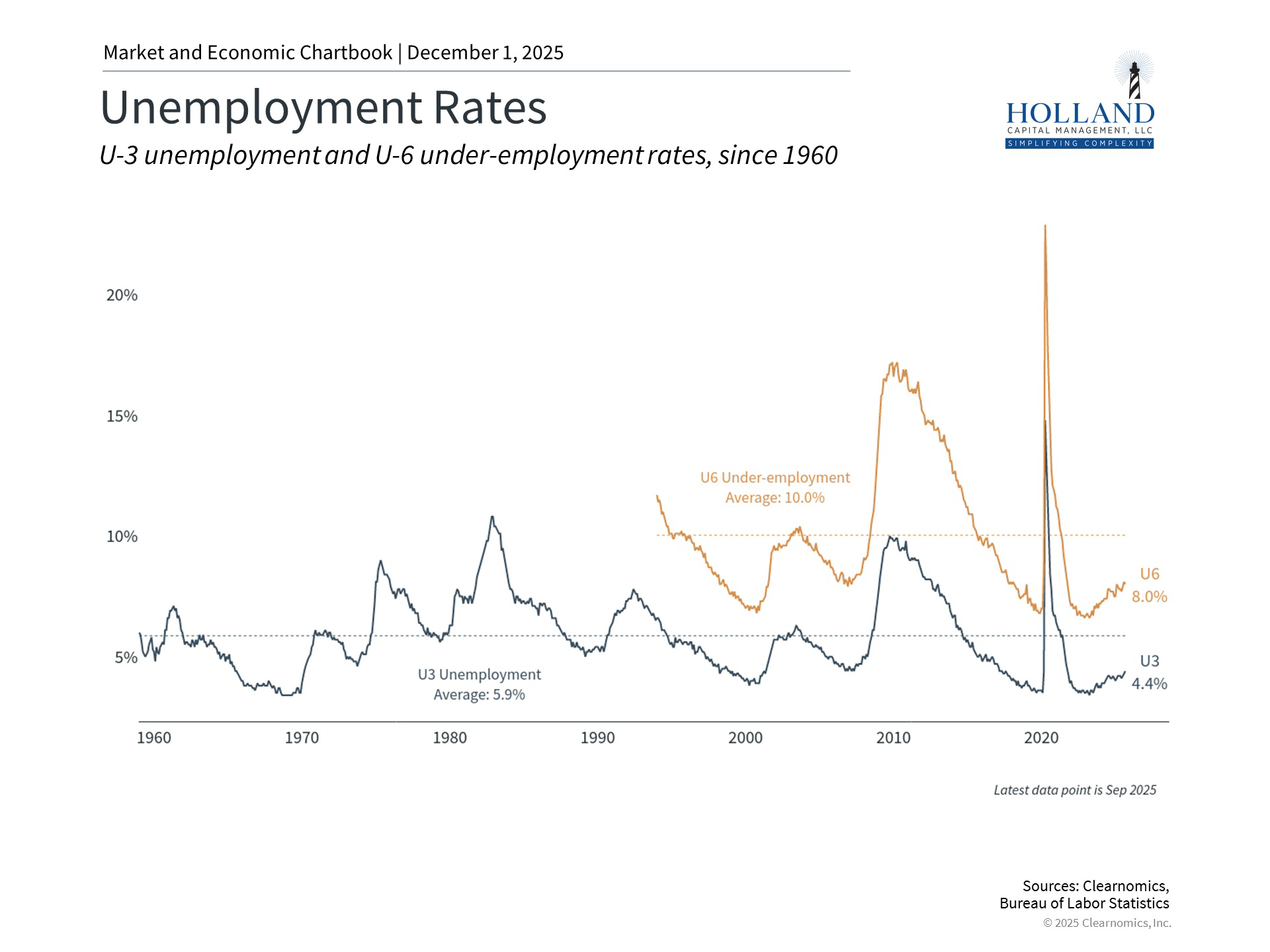
The delayed September jobs report showed 119,000 new jobs and a slight rise in unemployment to 4.4 percent. No October jobs report will be released due to the shutdown.
Markets briefly experienced a risk-off environment
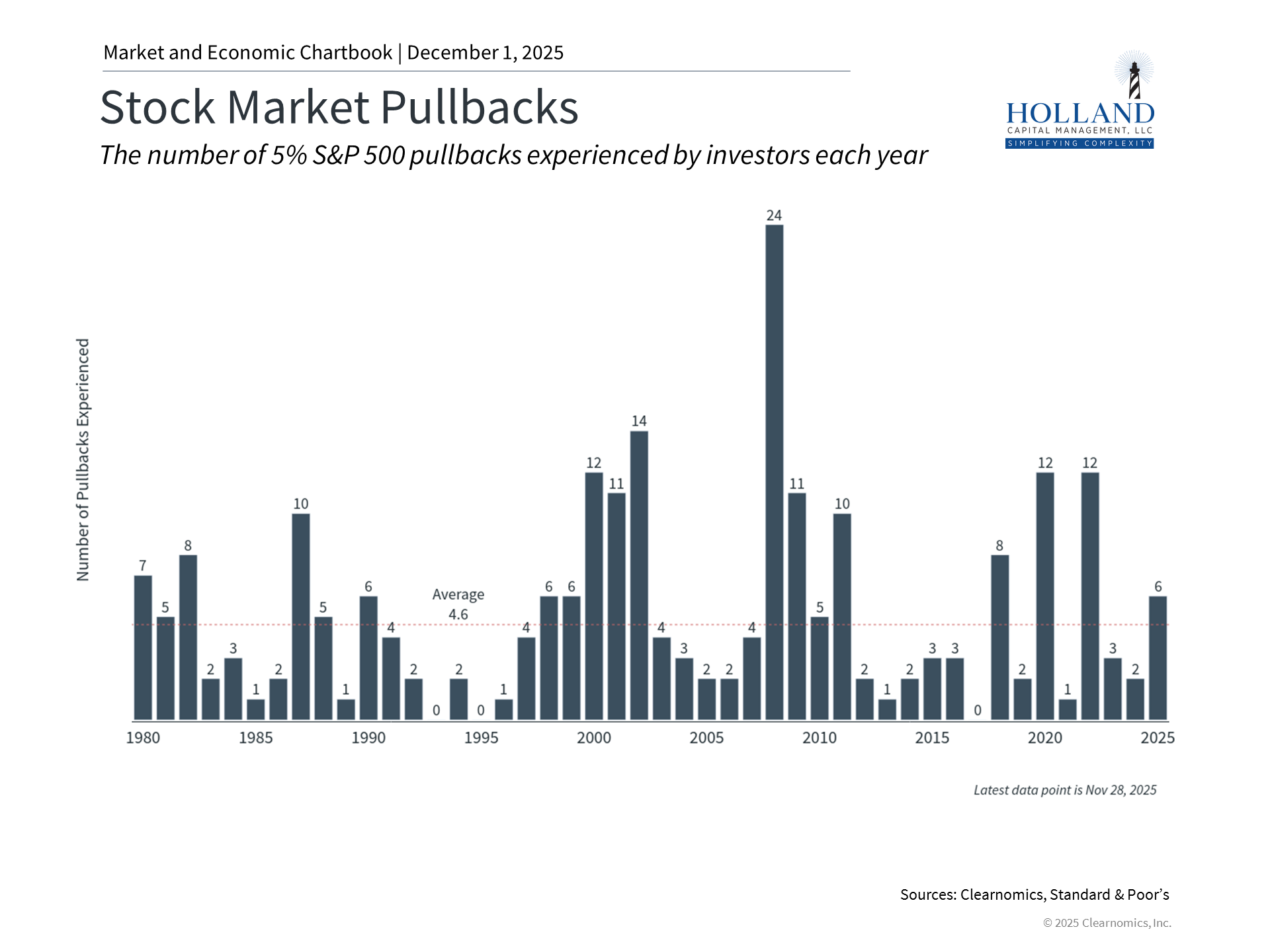
November brought a temporary shift away from risk-oriented sectors such as technology stocks, high-yield bonds, and cryptocurrencies. The primary driver was investor concern about the sustainability of AI-linked corporate performance and revised expectations around future Federal Reserve rate cuts. The S&P 500 has now experienced six declines of 5 percent or more this year, which is near long-term averages.
AI-related stocks posted their weakest week since April amid questions about spending levels, debt burdens, margins, and potential signs of overvaluation. Still, several notable companies reported substantial revenue and earnings, helping parts of the sector rebound.
Cryptocurrencies faced sharp selling pressure. Bitcoin fell more than 30 percent from October highs above 125,000 dollars and briefly traded below 85,000 dollars, erasing year-to-date gains. These movements demonstrate that crypto assets remain speculative and prone to meaningful swings. This reinforces the importance of disciplined risk management and an asset allocation aligned with long-term goals.
Bond markets strengthened in November, supported by declining long-term interest rates. The 10-year Treasury yield temporarily moved below 4 percent amid expectations for lower long-run rates. The strong year-to-date performance of the bond market has provided stability within diversified portfolios.
The government shutdown ended, but uncertainty remains
The 43-day government shutdown ended, although the federal government is only funded through January 2026. Political uncertainty will likely re-enter the headlines in the coming months. Markets generally looked past the shutdown, but the lack of economic data made it harder to assess short-term conditions.
The delayed September jobs report showed stronger-than-expected hiring, although revisions indicated that 4,000 jobs were lost in August. The unemployment rate rose to its highest level since 2021, though still low by historical standards.
There will be no comprehensive October jobs report, although partial data will be included in future releases.
Market expectations for the next Fed rate cut have shifted
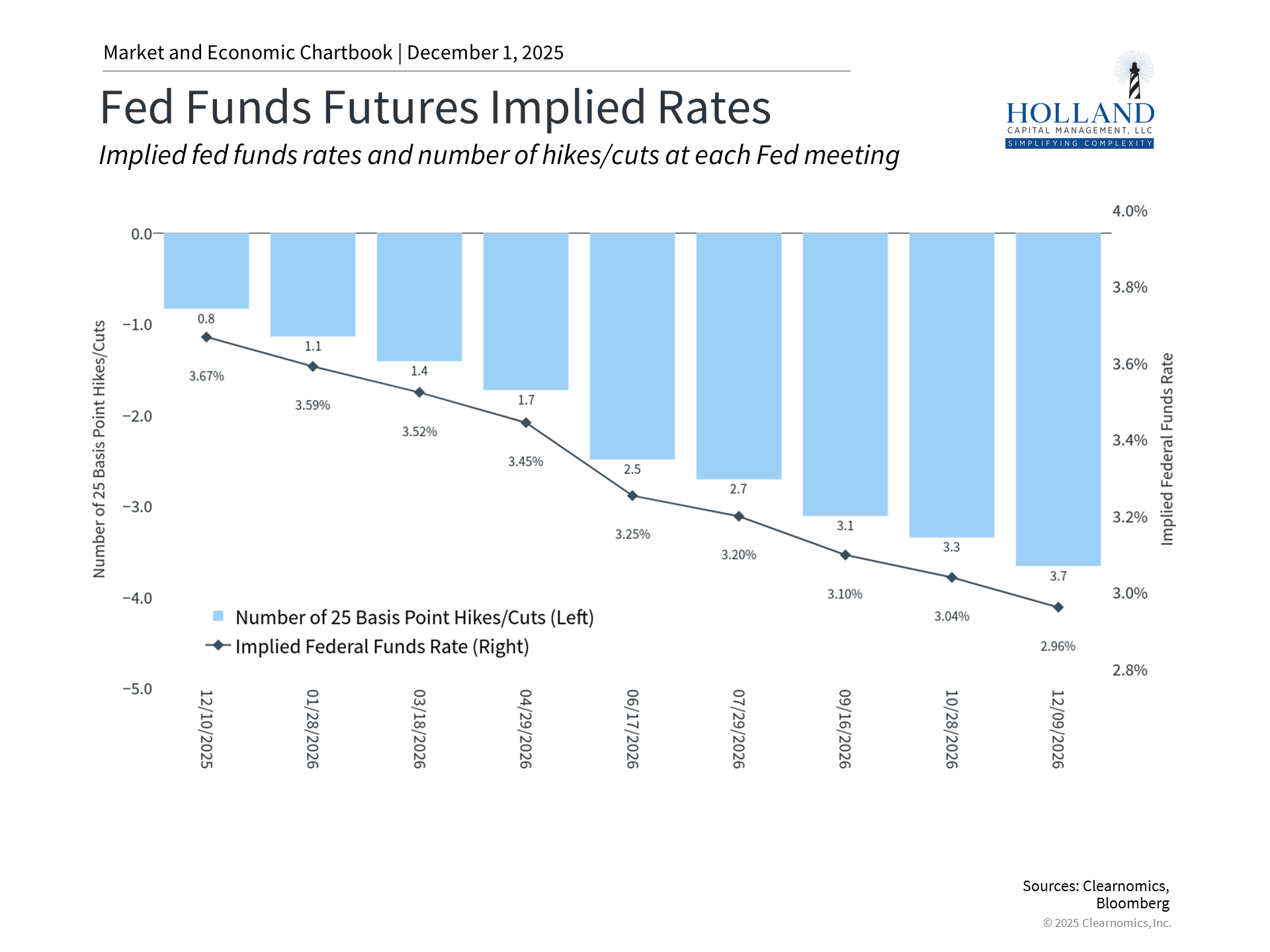
These data delays mean the Federal Reserve enters its mid-December meeting without a complete economic picture. Market expectations for a December rate cut fell sharply in mid-November before rebounding. Current pricing suggests rate cuts in December and again in April or June 2026.
Consumer sentiment also weakened. The University of Michigan’s Index of Consumer Sentiment declined from 53.6 to 50.3, reflecting concerns about job security, higher prices, and financial pressures. Despite this, weaker sentiment has not significantly reduced spending or corporate revenues.
Bottom Line
November’s volatility and continued economic uncertainty illustrate that market swings are normal. Investors benefit from maintaining a disciplined, long-term perspective as year-end approaches. A thoughtful financial plan, supported by investment management, retirement planning, tax planning, and broader financial planning, helps maintain clarity during uncertain periods.
For those evaluating how these dynamics affect their long-term goals, this is an opportunity to review allocations, revisit risk tolerance, and remain aligned with an intentional strategy. This environment reinforces the importance of a planning-led approach that keeps investors anchored to long-term objectives.
Is Holland Capital Management the Right Fit for You?
Start with a 15-minute Clarity Call. We will talk through your situation, what you are trying to solve, and whether working together makes sense.
Frequently Asked Questions
What caused the volatility in November?
Market volatility was primarily driven by concerns about AI-related stocks, shifting expectations for Fed policy, and delayed economic data. Risk-oriented assets experienced the sharpest swings, while bonds offered stability.
How did interest rates influence the market?
A decline in long-term Treasury yields supported bond prices and helped offset stock volatility. Expectations for future rate cuts shifted throughout the month as economic conditions evolved.
Did the government shutdown affect the data?
Yes. The shutdown delayed the September jobs report and eliminated the October report. This reduced visibility into the labor market at a time when the Federal Reserve is evaluating key policy decisions.
How should investors respond to this environment?
The most effective approach is to maintain a disciplined plan, avoid reacting to short-term moves, and ensure portfolios are aligned with long-term objectives. Financial planning helps investors remain focused and stay grounded in the plan.

