


The year began on a constructive note for investors. U.S. equity and bond markets extended the momentum from late 2025, reaching new highs despite several bouts of volatility. Headlines surrounding geopolitics, monetary policy, and commodities created short-term market swings, including the S&P 500’s sharpest single-day decline since October. Yet, these pullbacks proved temporary. Within days, markets recovered, supported by resilient corporate earnings and steady economic fundamentals.
January serves as a timely reminder that while uncertainty can dominate the news cycle, long-term outcomes are shaped more by earnings growth, valuations, and disciplined financial planning than by daily headlines.
Learn more about our approach to long-term investment planning and portfolio strategy. Volatility is likely to remain a feature of markets throughout 2026, but history shows that diversified portfolios aligned with long-term goals are best positioned to navigate these environments.
Key Takeaways
- January delivered positive returns for both stocks and bonds despite heightened volatility driven by geopolitical tensions and Federal Reserve policy.
- Market reactions to political headlines were sharp but short-lived, with fundamentals and earnings driving a quick recovery.
- Precious metals experienced a dramatic rally followed by a swift reversal, highlighting their volatility and role as a complement, not a replacement, to core holdings.
- Corporate earnings remained broadly healthy, supporting equity valuations even amid uncertainty.

When markets get volatile, clarity matters.
Download our educational guide, How to Protect Your Wealth in Challenging Markets.
Market and Economic Highlights from January
U.S. equity markets posted modest gains for the month. The S&P 500 rose 1.4 percent and briefly crossed the 7,000 level on an intraday basis. The Dow Jones Industrial Average gained 1.7 percent, while the Nasdaq Composite advanced 0.9 percent. Market volatility increased during the month, with the CBOE Volatility Index climbing above 20 amid geopolitical tensions before settling at 17.44 by month-end.
Bond markets were comparatively steady. The Bloomberg U.S. Aggregate Bond Index gained 0.1 percent even as long-term interest rates moved higher. The 10-year Treasury yield ended January at 4.24 percent, its highest level since September. Outside the U.S., returns were stronger. International developed markets gained 5.2 percent in U.S. dollar terms, and emerging markets rose 8.8 percent, benefiting from currency movements and improving global growth expectations.
On the policy front, the Federal Reserve held its benchmark rate in a range of 3.50 to 3.75 percent following three rate cuts in the second half of 2025. Inflation remained above the Fed’s target, with consumer prices rising 2.7 percent year-over-year and producer prices accelerating to 3.0 percent. Late in the month, President Trump announced his intention to nominate Kevin Warsh as the next Federal Reserve Chair, a development that influenced expectations around future monetary policy.
Geopolitical Events and Market Volatility
Geopolitical developments were a major source of market volatility in January. Early in the month, a U.S. operation in Venezuela led to the capture of Nicolás Maduro. Although the action was framed around narco-terrorism, investor attention quickly shifted to potential implications for global oil markets. Venezuela holds the world’s largest proven oil reserves, yet contributes less than 1% of global crude production due to infrastructure constraints. As a result, the primary transmission channel from geopolitical events to financial markets remained commodity prices, particularly oil.
Tensions increased further after U.S. statements about the potential purchase of Greenland, citing its strategic importance for defense and natural resources. Diplomatic disputes with NATO allies and related tariff concerns contributed to a sharp, short-lived market selloff. The S&P 500 experienced its worst day since October before rebounding after diplomatic discussions de-escalated and a framework for future negotiations was announced.
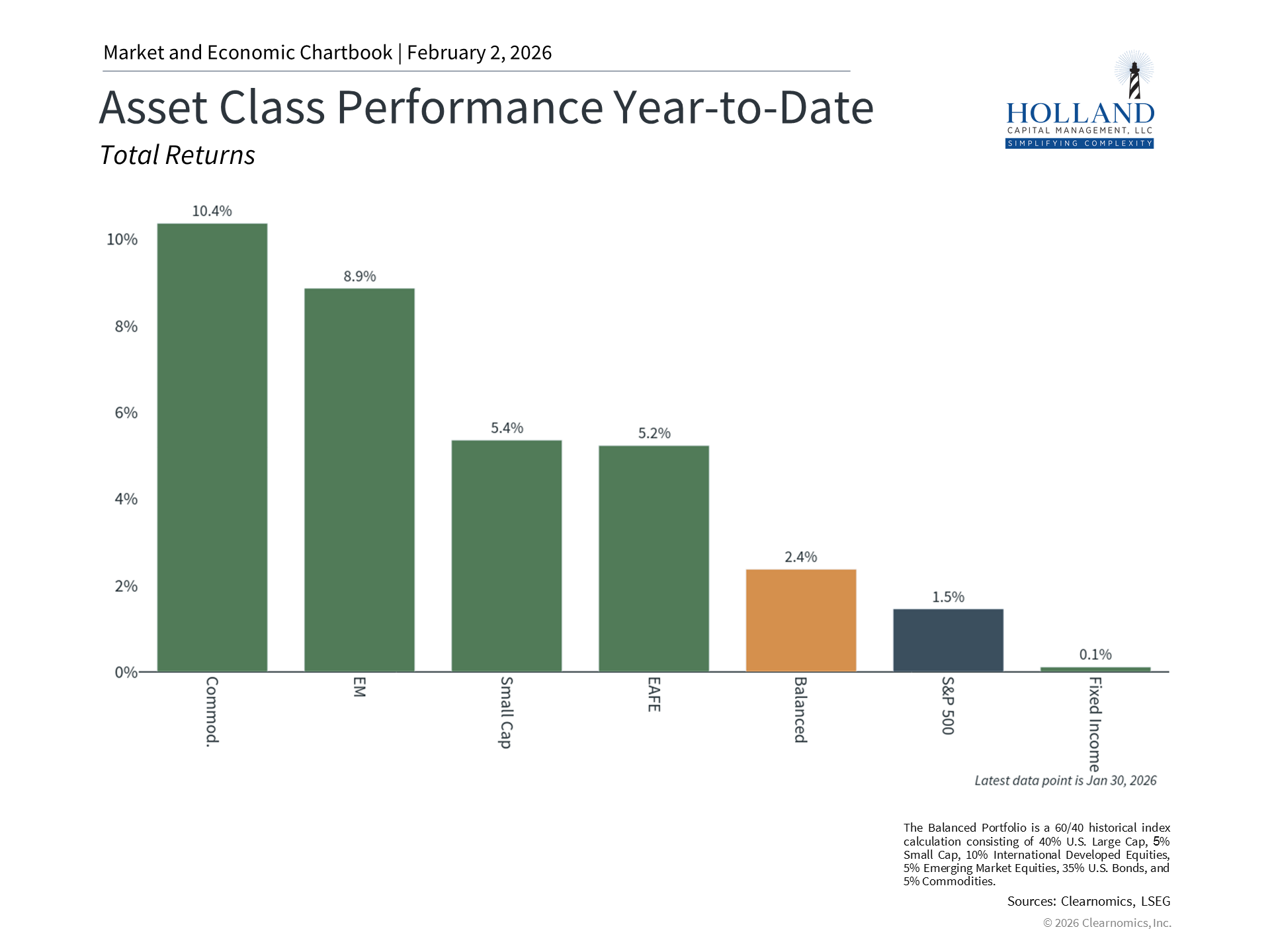
For long-term investors, episodes like these underscore an important lesson. Geopolitical shocks often have an immediate impact on sentiment, but their long-term economic effects are frequently overstated. Markets have historically recovered as uncertainty fades, reinforcing the value of maintaining a long-term perspective rather than reacting to short-term noise.
Federal Reserve Policy, Precious Metals, and the U.S. Dollar
Precious metals were among the most volatile assets in January. Gold surged to record levels, briefly approaching $5,600 per ounce on an intraday basis, while silver climbed above $120 per ounce. Geopolitical risk, central bank purchases, and concerns about Federal Reserve independence drove these moves. This dynamic is often described as the “debasement trade,” reflecting investor fears that fiscal deficits and accommodative monetary policy could weaken the dollar and fuel inflation.
Late in the month, however, sentiment shifted abruptly. The announcement of Kevin Warsh as the prospective next Fed Chair altered expectations around future interest rate policy. While Warsh has expressed support for lower rates in recent commentary, he has also taken a more hawkish stance in the past. Markets interpreted the nomination as signaling continuity and stability at the Fed, prompting a sharp reversal in precious metals prices and a modest rebound in the U.S. dollar.
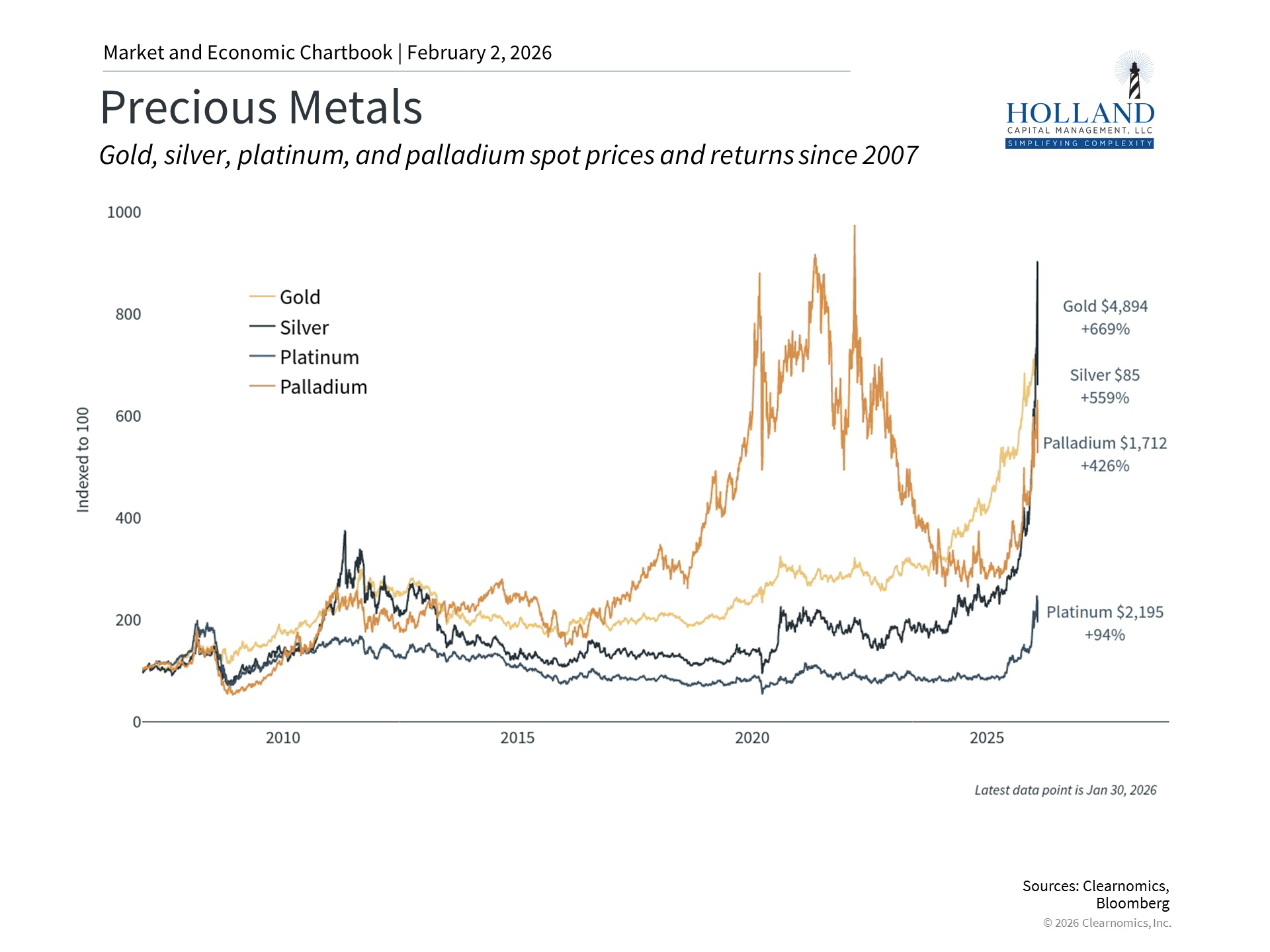
This reversal highlights two important considerations. First, precious metals can experience pronounced boom-and-bust cycles driven by shifts in policy expectations. Second, while they can play a role in diversified portfolios, their volatility reinforces why they are best used to complement core holdings in stocks and bonds rather than replace them.
Corporate Earnings Remain a Source of Stability
Away from geopolitical headlines, corporate fundamentals remained supportive. Fourth-quarter earnings reports showed continued strength across many sectors. According to FactSet, approximately one-third of S&P 500 companies had reported results by month-end, with roughly three-quarters exceeding expectations. If these trends persist, quarterly earnings growth is projected at nearly 11.9 percent, marking the fifth consecutive quarter of double-digit growth. On a trailing 12-month basis, earnings growth has accelerated to nearly 12.8 percent.
Investor attention has been particularly focused on technology and artificial intelligence-related companies, given their outsized contribution to recent market returns. While reactions to earnings in these sectors have been mixed due to high expectations, many other industries have delivered solid results, benefiting from broad-based economic growth.
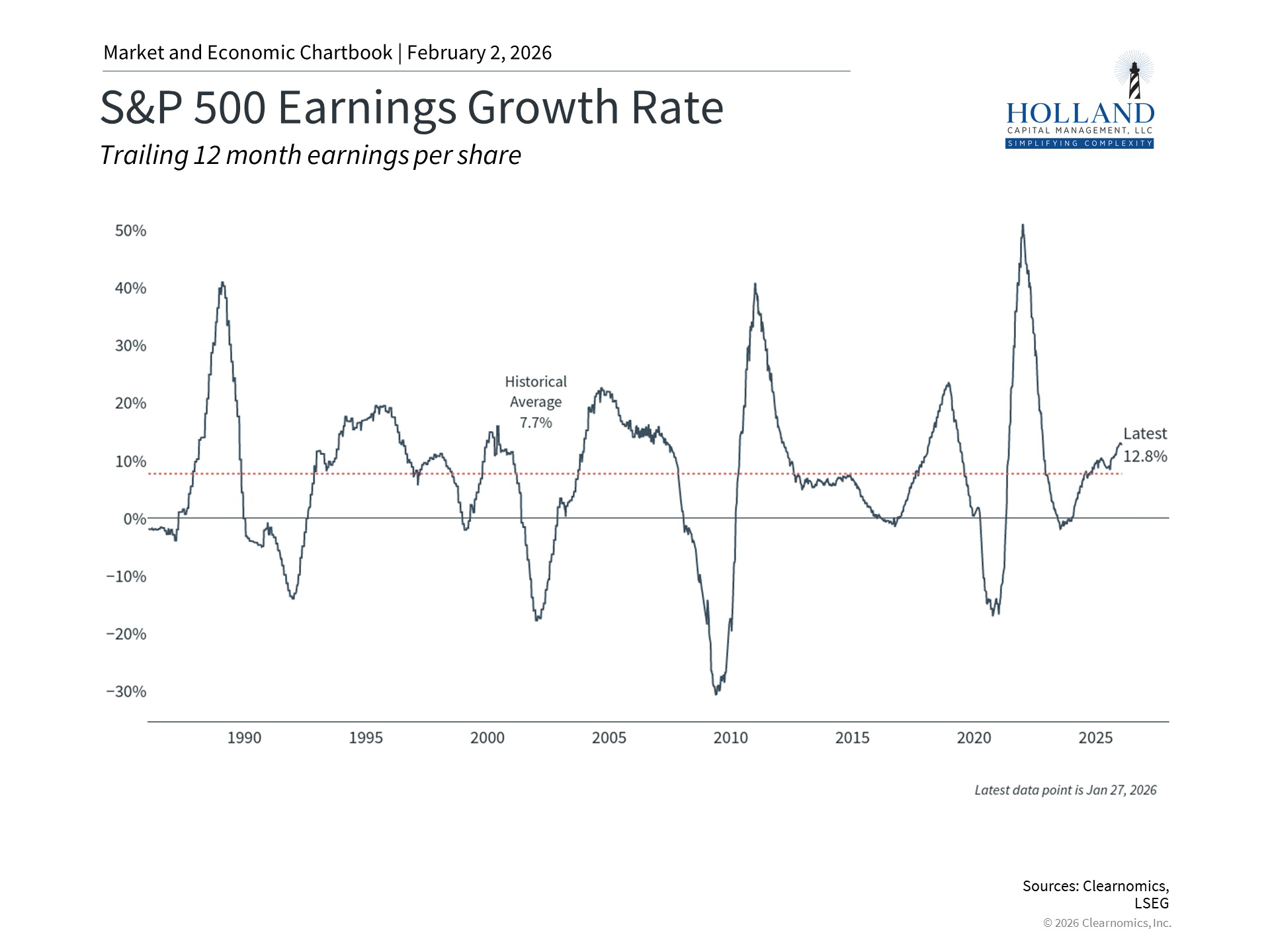
Strong earnings provide an important foundation for markets. Even during periods of heightened uncertainty, healthy profitability supports valuations, which is why major indices finished January in positive territory.
Weather-Related Disruptions and the Economy
January’s severe winter weather, known as Winter Storm Fern, affected more than half of the U.S. population across at least 21 states. The storm caused widespread power outages, travel disruptions, and temporary interruptions to economic activity. While such events can have meaningful short-term impacts, history suggests that weather-related disruptions rarely have lasting effects on the national economy.
The key distinction is whether productive capacity is permanently damaged or activity is simply delayed. In this case, most disruptions are expected to result in postponed, rather than lost, economic activity, particularly in sectors such as retail and construction.
Staying Focused on the Long Term
January’s market experience reflected the complex interplay of geopolitics, monetary policy, and economic fundamentals. While volatility surfaced at several points during the month, markets proved resilient. Equity indices reached new highs, corporate earnings remained strong, and diversified portfolios benefited from balanced exposure.
For long-term investors, the takeaway is clear. Market headlines will continue to shift, often rapidly. Maintaining a thoughtful asset allocation aligned with financial goals remains the most effective way to navigate uncertainty and stay grounded in the plan.
Is Holland Capital Management the Right Fit for You?
Start with a 15-minute Clarity Call. We will talk through your situation, what you are trying to solve, and whether working together makes sense.
Frequently Asked Questions
Where are precious metal prices headed now?
Precious metal prices are currently influenced by global economic uncertainties and inflationary pressures. Analysts predict a potential upward trend in 2026, driven by increased demand for safe-haven assets. Thus, investors should stay informed about market conditions and geopolitical developments that could affect the January 2026 market commentary and inform strategic investment decisions.
Why did markets rise despite geopolitical uncertainty?
Earnings, economic growth, and liquidity primarily drive markets. While geopolitical events can create short-term volatility, their long-term impact is often limited if underlying fundamentals remain strong.
What caused the sharp reversal in gold and silver prices?
Precious metals rallied on concerns about inflation and monetary policy, then reversed after the announcement of a new Federal Reserve Chair nominee shifted expectations around future interest rates.
How should investors think about volatility in 2026?
Volatility is a normal feature of markets, particularly during periods of policy transition and geopolitical uncertainty. A diversified portfolio aligned with long-term goals can help manage these fluctuations.
Do weather events like Winter Storm Fern affect long-term economic growth?
Severe weather can temporarily disrupt activity, but unless productive capacity is permanently damaged, these events tend to shift economic activity rather than reduce it over the long term.

