


Key Takeaways
February’s headlines masked an important shift beneath the surface.
• Market leadership broadened — international stocks and small caps outperformed while large U.S. indexes paused.
• The Supreme Court tariff ruling reshaped trade policy but did not eliminate ongoing trade uncertainty.
• AI valuation concerns triggered a meaningful sector rotation across equity markets.
• Falling Treasury yields below 4% supported bond returns and reinforced diversification benefits.
February was a reminder that markets rarely move in a straight line. After January’s strong momentum pushed major indexes toward fresh highs, the tone shifted as investors digested a landmark Supreme Court tariff ruling, evolving narratives around artificial intelligence, softer labor data, and rising geopolitical tensions. Volatility returned to equity markets, yet leadership broadened beneath the surface. International stocks, small-cap stocks, and bonds all provided offsetting strength.
Rather than reacting to individual headlines, disciplined investors benefit from maintaining a diversified portfolio.

When markets get volatile, clarity matters.
Download our educational guide, How to Protect Your Wealth in Challenging Markets.
A Supreme Court Ruling Reshapes Trade Policy
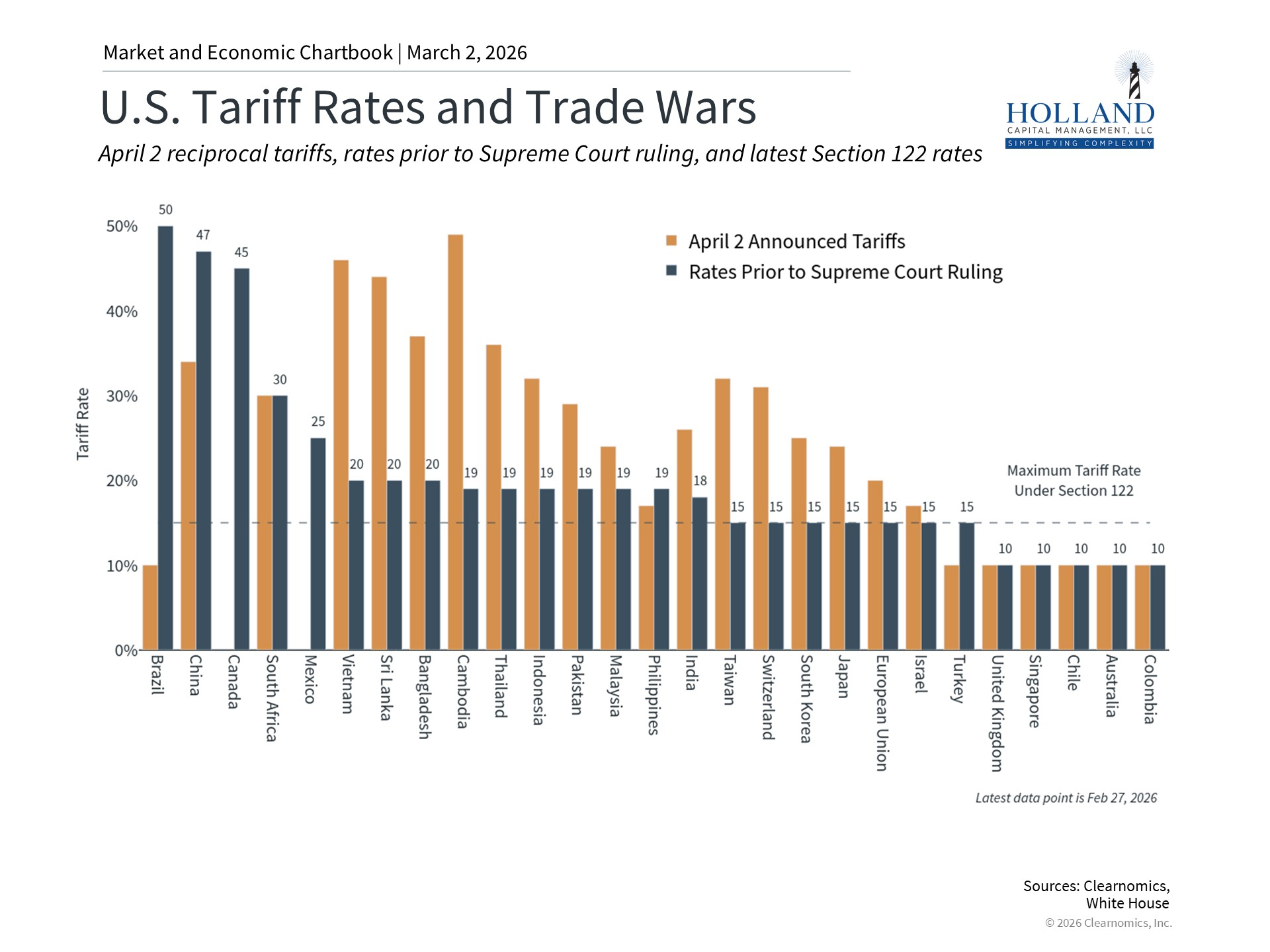
On February 20, the Supreme Court ruled against the administration’s use of IEEPA-based reciprocal tariffs. The decision did not eliminate tariffs, but it reshaped the legal framework governing trade actions. In response, policymakers pivoted to Section 122 of the Trade Act of 1974, allowing temporary tariffs of up to 15% for 150 days, while also exploring additional authority under Sections 301 and 232.
For markets, the key issue is not the specific statute invoked, but the persistence of trade uncertainty. While headline risk can trigger short-term swings, companies historically adapt through pricing adjustments and supply chain diversification. Over time, markets recalibrate to new trade realities.
The bond market reflected this shift in tone. The 10-year Treasury yield briefly fell below 4%, supporting returns in fixed income and reinforcing the stabilizing role of balanced portfolios. Treasury yields remain an important signal of investor expectations surrounding growth and inflation.
AI Enthusiasm Versus Valuations
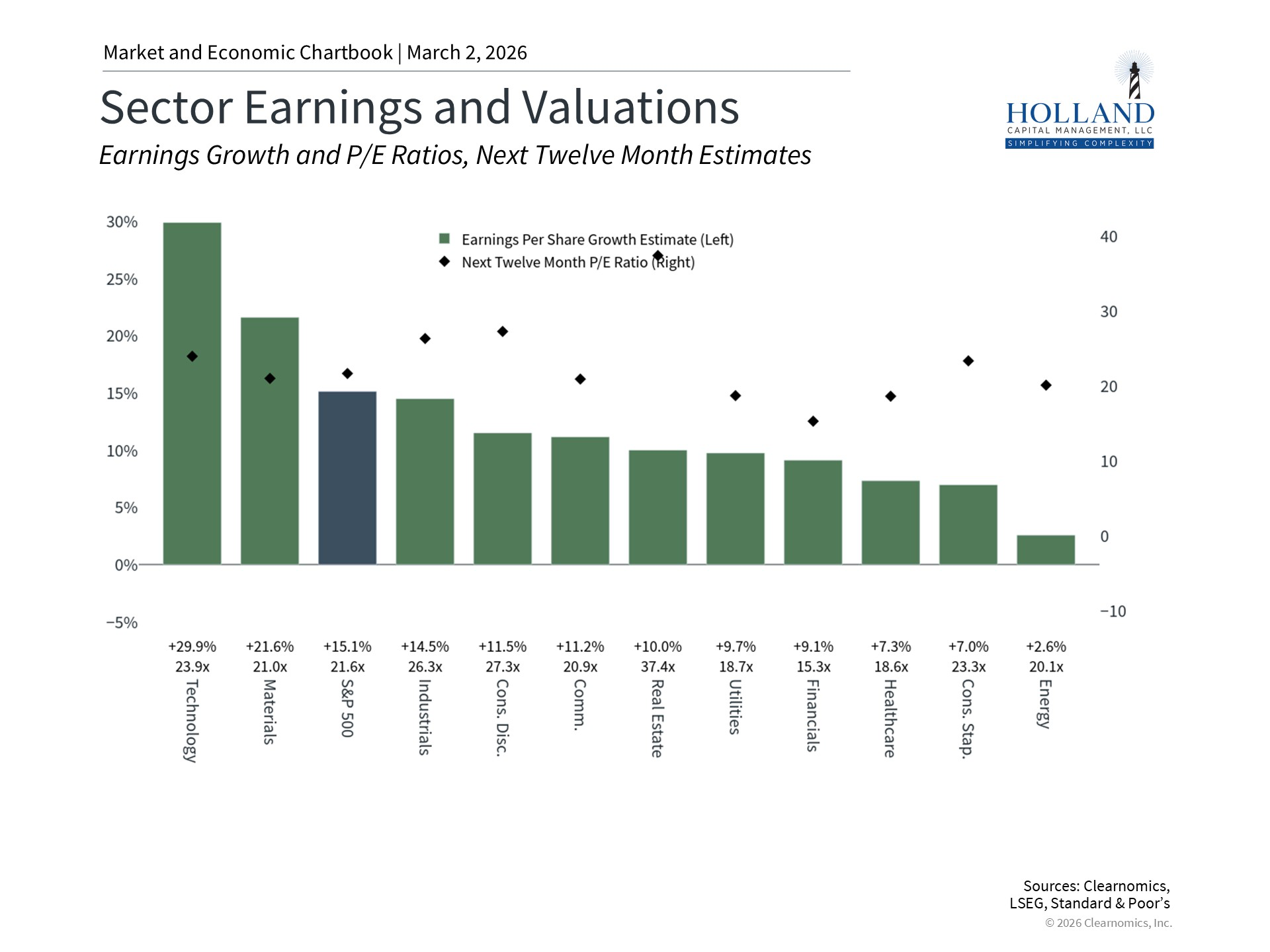
Artificial intelligence remained central to market discussions in February, though the conversation shifted from optimism to scrutiny. Investors began focusing more closely on valuation risk and the pace of disruption across traditional industries.
Concerns that AI-driven automation could compress software margins and accelerate workforce displacement contributed to a meaningful market rotation. Capital flowed away from concentrated mega-cap positions toward sectors perceived as more durable, including energy, materials, and industrials. This shift toward what some describe as heavy-asset, lower-obsolescence businesses broadened participation across the equity market.
Periods of rotation can feel uncomfortable, but they often represent healthy recalibration within a disciplined asset allocation framework.
Growth Cooled While the Labor Market Sent Mixed Signals
Economic data presented a mixed picture. Real GDP expanded at a 1.4% annualized pace in the fourth quarter of 2025, down from the prior quarter. Business investment remained firm, particularly in AI-related infrastructure, but consumer spending softened amid lingering disruptions.
Labor market data added complexity. While the unemployment rate edged down to 4.3%, annual benchmark revisions revealed slower job creation throughout 2025 than previously estimated. Some economists characterize this environment as jobless growth, where economic output expands but hiring lags.
Inflation readings remained contained, though the core PCE price index showed the sharpest monthly increase in a year. The interplay between slowing growth and moderating inflation continues to shape monetary policy expectations.
For households, these dynamics reinforce the importance of proactive retirement planning and prudent long-term decision-making.
International Stocks and Small Caps Led the Way
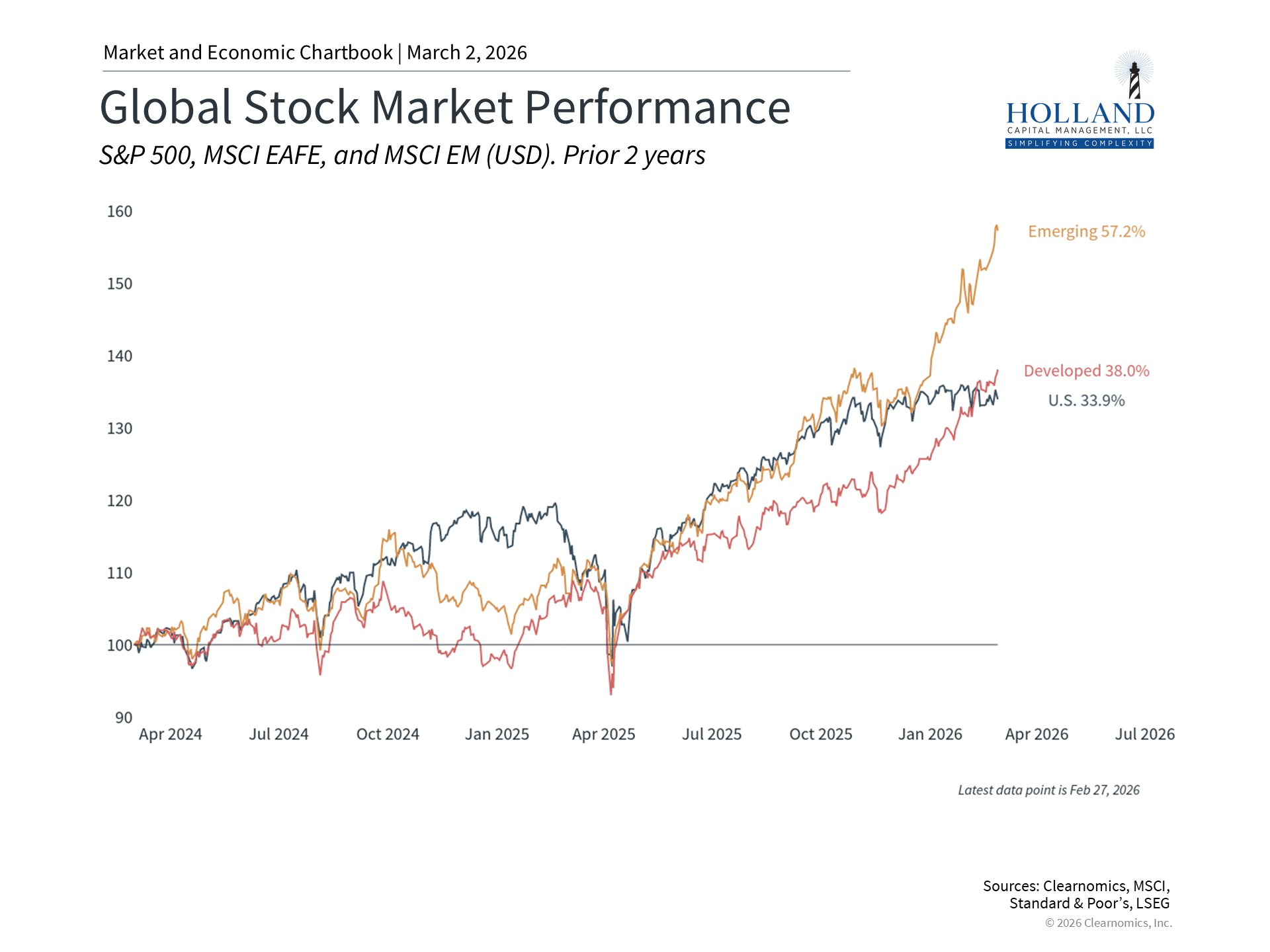
One of the most constructive developments in February was the continued outperformance of international markets and emerging markets. Developed markets advanced nearly 5%, while emerging markets delivered even stronger gains. Meanwhile, the Russell 2000 strengthened, underscoring renewed interest in smaller companies.
This broadening of market leadership represents a positive shift after several years of concentrated performance within a narrow group of U.S. technology companies. A weaker dollar earlier in the year also supported global returns when translated back into U.S. terms.
Precious metals experienced volatility amid geopolitical uncertainty and fiscal concerns, illustrating that alternative assets can contribute to diversification but also carry meaningful price swings.
The Bottom Line
February’s headline volatility masked an encouraging development beneath the surface. While large-cap U.S. stocks paused, strength in international equities, small caps, and bonds reinforced the benefits of thoughtful diversification. A long-term investment strategy remains the foundation of durable wealth creation.
Headlines surrounding tariffs, artificial intelligence, inflation, and geopolitical developments will continue to evolve. However, history consistently shows that disciplined positioning, rather than reactive decision-making, drives sustainable results.
The objective remains clear: preserve capital where appropriate, strengthen financial foundations, and grow wealth responsibly over time — staying grounded in the plan.
Getting Started with Holland Capital Management
If you’re evaluating financial decisions in today’s market environment, request a Clarity Call to discuss our planning and investment approach.
Frequently Asked Questions
What drove market volatility in February 2026?
Volatility stemmed from a Supreme Court tariff ruling, evolving AI valuation concerns, mixed labor market data, and escalating geopolitical tensions.
Why did international markets outperform?
A weaker U.S. dollar, improving global growth expectations, and rotation away from concentrated mega-cap stocks supported international gains.
Is the labor market weakening significantly?
Unemployment remains historically low, but benchmark revisions show slower job creation, creating mixed economic signals.
Should investors adjust portfolios during rotations?
Market rotations are normal. Long-term success typically results from a disciplined strategy rather than a short-term reaction.
