


For much of this year, the market climbed while the news gave people every reason to sell. July was the month that finally caught up with it. The major indexes slipped, Treasury yields pushed toward levels we have not seen in almost two decades, oil jumped as the Middle East flared again, and the Federal Reserve held rates steady while its own committee argued about whether it should have.
None of that erased the year. The broad market is still close to a record high, and the gains built through the spring are still there. What July offered was a reminder of something easy to forget during a calm stretch: a good year does not arrive in a straight line, and the months that test your patience are often the ones that reward a plan. Here is what actually moved, and how I am reading it.
Key Data Points for July
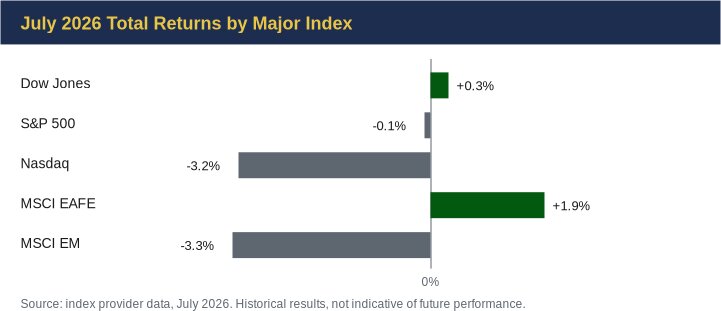
- The S&P 500 slipped 0.1% and the Nasdaq fell 3.2%, while the Dow Jones Industrial Average gained 0.3%.
- The VIX volatility index spiked as high as 21 mid-month before settling back near 16.
- Developed international markets rose 1.9% (MSCI EAFE), while emerging markets fell 3.3% (MSCI EM).
- The 30-year Treasury yield reached a 19-year high near 5.28%, and the 10-year ended July around 4.74%.
- The Bloomberg U.S. Aggregate Bond Index fell 1.3%.
- Brent crude briefly topped $100 a barrel before settling near $90; WTI ended near $85. Gasoline held around $4.10 a gallon.
- The Federal Reserve held its target rate at 3.50% to 3.75% in a divided 9 to 3 vote.
- Second quarter real GDP grew at a 1.5% annual rate, down from 2.1% in the first quarter.
Figures reflect July 2026 and are historical. Historical results are not indicative of future performance.

RETIREMENT ENGINEERING™
The Order Matters
Five retirement decisions and why timing matters.
AI turned volatile, and the market leaned on more than technology
The loudest story of the month started with earnings. Second quarter results put the biggest technology companies under a brighter light, and investors asked a fair question: the largest firms are spending hundreds of billions of dollars building data centers and AI infrastructure, so when does that spending start showing up as profit? There is no settled answer yet, and markets dislike an open question. Technology stocks swung hard as people tried to price it.
The volatility was not limited to the United States. Chip makers sold off around the world, and South Korea’s KOSPI 200 dropped 24% in July after a strong run through 2025. A Chinese company, Moonshot AI, released a capable new model called Kimi K3 that anyone can run on their own hardware, which reopened the debate over how much computing power the next phase of AI could actually require and who might lead it. Late in the month, the ratings agency Fitch went further, flagging what it called a major credit risk across the AI ecosystem, pointing to how tightly the financing and supply arrangements among the big players are wired together.
I do not read any of that as a reason to abandon the theme. I read it as a reason to keep it in proportion. AI is one powerful force in the market, not the whole market. Look under the surface of this year and other parts of the economy have carried real weight, Energy and Industrials among them. When the leadership of a market broadens out like that, the investors who own a genuine mix of businesses tend to feel it less when any single group stumbles.
Oil spiked as the Middle East flared again
Energy was the other shock of the month, and it came fast. A fragile ceasefire broke down, the United States conducted fresh airstrikes on Iranian military sites, and traffic slowed through the Strait of Hormuz, the narrow channel that a large share of the world’s oil passes through every day. The pressure spread to a second waterway when Houthi forces struck Saudi tankers near the Bab al-Mandeb Strait in the Red Sea. Oil is a market that reacts first and asks questions later.
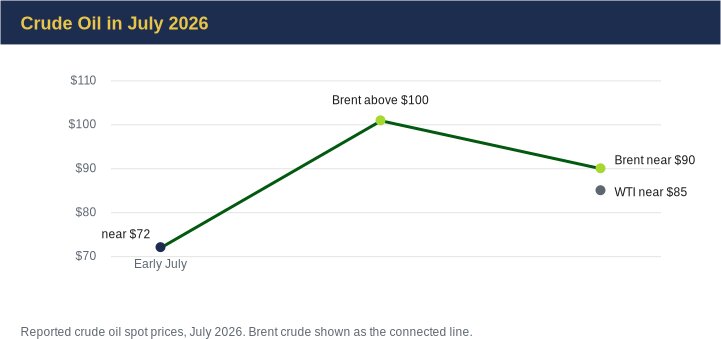
Brent crude jumped above $100 a barrel at the peak of the tension before easing back toward $90 by the end of the month. To put that in context, oil had traded as low as $72 in early July, so the round trip was sharp. Higher energy prices matter well beyond the gas pump, because they feed straight into the cost of moving goods and running a household. With gasoline holding near $4.10 a gallon, oil is one of the reasons headline inflation could stay stickier than many people expected coming into the summer.
The Fed held, but the committee split
At its July meeting, the Federal Reserve kept its target rate in a range of 3.50% to 3.75%. The headline was the hold. The more interesting detail was the vote. Three officials dissented in favor of raising rates, a level of open disagreement inside the committee that has not shown up since September 2016. When policymakers who usually speak with one voice start splitting three ways, it tells you the debate about inflation is far from over.
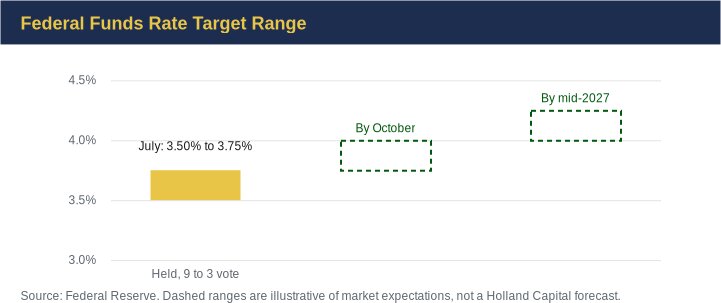
Part of what makes this moment harder to read is a change in how the Fed communicates. The new chair, Kevin Warsh, has deliberately said less. The statements are shorter, and he has stepped back from the detailed forward guidance the market grew used to. Less hand-holding from the Fed means investors are left to guess a little more, and that uncertainty tends to show up as movement in bond yields. Both nominal and real yields climbed to their highest levels in years during July, and market pricing now points to a possible increase by October, with the chance of another by the middle of 2027.
Here is the part worth sitting with. Higher yields feel uncomfortable, but for a long-term investor they are not only a risk. They are also the first genuinely attractive income we have seen from high-quality bonds in a long time. A portfolio that holds bonds for stability and income has more to work with today than it did through much of the past decade.
New tariffs added another layer of uncertainty
Trade policy shifted again in July, and the path there was unusual. After the Supreme Court ruled that last year’s reciprocal tariffs were not legal under the emergency powers the administration had used, the White House rebuilt them under different trade laws. When one of those authorities expired during the month, another set of tariffs went into place under a separate rule. The practical result is that many countries now face tariffs in the range of 10% to 12.5%, and certain Canadian goods, including cement, dairy, and alcohol, face a rate as high as 50%.
Tariffs are the kind of story that sounds alarming in the moment and reveals itself slowly. They do raise costs for specific industries and products, and some of that reaches consumers. Over time, though, companies adjust, supply chains reroute, and pricing shifts. Many of the worst-case fears attached to trade policy over the past year have not played out the way the headlines suggested, even as the economy kept growing and the market set new highs along the way. That history is not a promise about what comes next, but it is a useful anchor when the next tariff headline lands.
What this means for your portfolio
My job is not to predict which of these stories dominates August. It is to build portfolios that do not depend on getting that prediction right. That is why I work in individual stocks and bonds chosen for each client rather than a one-size box of packaged funds. Owning the actual securities lets me manage concentration when one part of the market runs hot, target taxes with intent, and shape a mix that fits your plan instead of an index.
July fits neatly into how I think about that work. Higher yields give the bond side of a portfolio a real role again, which is a welcome change for anyone leaning on their savings for stability or income. A market that is broadening beyond a handful of technology names rewards being diversified rather than crowded into last year’s winners. And the volatility around AI, oil, and the Fed is exactly the kind of noise a disciplined investment approach is designed to absorb. If you are drawing on your portfolio in the years ahead, this is also a natural moment to revisit how your retirement plan is positioned for a higher-rate world.
Frequently Asked Questions
Why did the market fall in July if the year is still positive?
July was a case of several pressures arriving at once. Technology stocks pulled back as investors questioned the payoff on enormous AI spending, oil spiked on Middle East tensions, and Treasury yields climbed as the Fed signaled less certainty about its next move. Each of those alone might have been absorbed, but together they weighed on prices. It helps to keep the scale in view: the S&P 500 slipped only about 0.1% for the month and the broad market remains near a record high. A modest step back inside a strong year is normal market behavior, not a warning by itself.
What do higher Treasury yields mean for my portfolio?
Higher yields cut in two directions. The price of bonds you already own can fall when rates rise, which is part of why the broad bond index was down in July. At the same time, new bonds and cash now pay meaningfully more income than they have in years, which can strengthen the stable part of a portfolio over time. For a long-term investor, that shift tends to make high-quality bonds more useful, not less. The right balance depends on your goals and your time horizon, which is worth reviewing as the rate environment changes.
Should I be worried about the volatility in AI and technology stocks?
Volatility and trouble are not the same thing. The swings in AI-related stocks reflect a real and healthy debate about how quickly heavy spending turns into profit, and that debate could take quarters to resolve. History suggests markets often overestimate how fast a new technology pays off, even when the long-term potential is real. The steadier path is to hold AI as one theme inside a broader mix rather than making it the whole portfolio. That way a rough stretch for a few large names does not set the tone for everything you own.
How could the Middle East conflict and higher oil prices affect me?
The most direct effect shows up at the gas pump and in the cost of anything that has to be shipped or produced with energy. With gasoline near $4.10 a gallon, higher oil can keep inflation firmer, which in turn influences how the Fed thinks about rates. Markets also tend to move on the headlines around a conflict before the economic impact is clear, so short bursts of volatility are common. For many long-term investors, the sound response is to stay diversified across sectors, including areas like energy that can benefit when oil rises, rather than trying to trade each development.
What does the Fed’s decision to hold rates mean going forward?
Holding rates steady in a divided vote tells you the Fed is genuinely uncertain, with some officials more worried about inflation than others. Market pricing currently points to a possible rate increase by October and the chance of another by the middle of 2027, though those expectations can shift with the data. The practical takeaway is that rates may stay higher for longer than many assumed a year ago. That reinforces the case for a portfolio that can earn attractive income from bonds while staying diversified on the equity side.
The bottom line: July was a reminder that a strong year still includes uncomfortable months. The same forces that rattled the market can also create opportunity for investors who stay balanced and patient: volatile AI stocks, higher oil, and a divided Fed all cut both ways. Staying focused on your plan, rather than the day’s headlines, is still the best way to work toward your financial goals.
Is Holland Capital Management the Right Fit for You?
Start with a 15-minute Clarity Call. We will talk through your situation, what you are trying to solve, and whether working together makes sense.
Holland Capital Management, LLC (“HCM”) is a state-registered investment advisor with the North Carolina Department of the Secretary of State, Securities Division, and the Florida Office of Financial Regulation. Registration with state authorities does not indicate a specific level of skill or training.
This commentary is provided for educational and informational purposes only as of August 3, 2026. It should not be construed as individualized or personalized investment advice, a solicitation, or a recommendation to buy or sell any security or to adopt any investment strategy. The views expressed are those of HCM and are subject to change without notice as market conditions evolve.
All economic and market data referenced is historical and obtained from sources believed to be reliable, but its accuracy and completeness are not guaranteed. All investing involves risk, including the potential loss of principal. Stocks can decline in value, and bond prices and yields move as interest rates change. Past performance is not indicative of future results, and historical results are not a guide to future performance.
Any strategies discussed may not be suitable for all investors. Individuals should consult with a qualified financial advisor, certified public accountant, or attorney before making any financial decision.
